Why I won’t be buying a new TV this Christmas
I’m probably one of the only people in my neighborhood that hasn’t upgraded to a flat-panel TV. There, taking up a good portion of my living room, is the big-old-honking Sony.
Why haven’t I gotten rid of the beast? For one thing, it still works fine. And besides, I don’t watch that much TV.
OK, the real reason is fear. Setting up a new TV has become more complicated and intimidating than setting up a computer. I remember the days of having to reinstall software, update drivers, and doing dozens of other things by trial and error to get PCs to work. It didn’t take hours; it took days. But the computer industry has improved the process immensely. It’s still not idiot-proof, but at least I don’t need a degree in computer science to do it.
Meanwhile, TVs have moved in the other direction. Rather than just plugging them in and turning them on, you have to be an electronics engineer to get everything connected and playing well together.
My sister’s experience is a perfect example. Last spring, she and her husband bought a 46-inch flat-screen HDTV. With a beautiful picture like that, of course they wanted to complement it with the best audio and video components. But integrating all the components – Blu-Ray player, stereo receiver, CD player, cable and Internet – turned into what she calls her “high-end nightmare.”
The Best Buy salesman assured them that the Geek Squad could do it all. The Geeks came, they installed and connected everything, quickly demonstrated how everything worked, and then they were gone. But the head geek reassuringly left them his card, so they could call him personally if they had any problems.
An hour later, they had problems, and thus began “six months of hellish trial and error.” There was finger pointing between the Geek Squad and Comcast, then the head geek simply ignored my sister’s voicemails. Comcast came and switched out the cable box several times before one of the technicians finally admitted that the Comcast remote didn’t communicate with several of the new components. My sister and brother-in-law were on their own.
Once they got the BluRay player hooked up and tried to play a BluRay disc from Netflix, an error message popped up on the TV screen saying the BluRay player required a software upgrade. They hadn’t planned to connect the TV to the Internet yet, but now they had to in order to get the upgrade they needed. But the TV wouldn’t connect with their WiFi network. They had to call in a home multimedia specialist, at $140 an hour, and even he had trouble making it work.
Now, six months later, they’ve mostly figured it out. But they need four different remotes, depending on what component they’re trying to control. They keep notes near the TV so they can remember how to turn various components on and off. And they can’t play a simple audio CD without the TV monitor booting up and running rhythmic patterns of color to illustrate the music.
The total cost of the TV, components and fees for various technicians: more than $2,500. The time spent tinkering in frustration and chasing after the Geek Squad, Comcast and other technicians: 50-plus hours. “The sheer mental anguish – priceless,” my sister deadpans.
Who needs that? That’s why I’m buying a new computer this year. In fact, I may even throw out the old Sony and put the new PC in the living room. After all, with the PC, it’s easy to watch movies and TV shows, listen to my music and tune into the radio. Oh, and did I mention it can access the Internet, too?
Credit card fraud and the mystery of the Gevalia coffee
I was surprised to find a huge package sitting on my front porch last week. I hadn’t ordered anything, so I figured it must be a gift, even though it was too late for my birthday and too early for Christmas.
Inside was an assortment of coffee, a travel mug, a stainless steel carafe and a fancy 12-cup coffee maker, all from a company called Gevalia. Whoever sent this, I thought, doesn’t know me very well. I like coffee, but I’m not the kind of gourmet who would appreciate this sort of high-end beverage. (I’m more the Dunkin’ Donuts type.) Then I looked at the packing slip, which said that I had ordered it and paid with my Visa card.
Uh-oh. I sat for a couple of minutes, trying to figure out if there was any way that I could’ve inadvertently placed such an order. Then I called the company and explained what happened. Mysteriously, someone had used my name, address and Visa number (she verified it by reading me the last four digits) to place the order. But they had a different phone and different e-mail address, which she gave to me. She also noted the exact time of the order, which was while I was driving to see my son at college. She said she’d put a fraud alert on the order and told me to keep the goods for my trouble.
I then called the phone number that was associated with the order. It was a non-profit organization a couple of miles away from me. When I told the receptionist that someone was using their phone number in a case of credit-card fraud, she mentioned that she’d had several calls like this. She didn’t know what was going on.
I was tempted to send an e-mail to the address I had, but I thought that then the thief would have my e-mail address.
My next call was to Visa to find out what else might have been charged to the card. Luckily, there were no other charges. We immediately cancelled the card, Visa placed a fraud alert on the number, and I was issued a new one.
The whole incident baffled me. Although I was concerned that someone somehow got hold of my credit card information, I was not that surprised. I take reasonable precautions, both online and off (I shred all my mail), but I’ve done enough reporting on Internet security to know how easy it is for thieves to get your number. And even if you never use a credit card online, your financial institution keeps all that information on a computer somewhere, a computer that can often be just as easily hacked.
What baffled me the most: who was this person who would use my credit card to order coffee and send it to my house? I imagined some teenage hacker-in-training, just trying out his skills to see if he could get away with it. Or maybe it was someone in my neighborhood who pulled my information off my WiFi network, ordered coffee and hoped to pick it up from my doorstep before I noticed?
Then I did a little research online and found that this has been an ongoing problem with Gevalia, dating back to 2008. There is a formal complaint lodged with the Justice Department in the state of Delaware, where Gevalia is located.
Now I’m doubly baffled. Why would a merchant do this? Are they hoping that some of us actually think we ordered the coffee but forgot? And how did Gevalia, with whom I’ve never done business, get my credit card information? I’ll never know. But I consider myself exceedingly lucky that my only experience with credit card fraud (so far) cost me nothing but a couple of phone calls and gained me some cool coffee paraphernalia.
No more hiding for us freelancers
My days of working in a bathrobe are numbered.
One of the joys of freelancing is that I don’t have to get dressed up to go to work. In fact, I don’t even have to get dressed. I do, of course, eventually. But when I have loads of work or a pressing deadline, I stay in my pajamas. All in the name of efficiency, of course. Why spend time on clothes, hair and makeup when nobody’s going to see me anyway, except maybe the FedEx man?
But now that integrated webcams have become a standard feature in most laptops, rudimentary video conferencing through services like Skype and Google video chat are becoming more common. I started to realize this when my son went off to college this fall. He was amazed that he couldn’t video chat with me. (I was amazed that he wanted to. It was probably just a momentary lapse caused by the novelty of the webcam on his college-issued laptop combined with a golden opportunity to make me feel clueless.)
Initially I thought maybe we could keep this Skype thing just between me and family. Then in October Cisco introduced Umi Telepresence , a video conferencing system for the home. The system, which retails for $600, includes a camera that connects to a high-definition TV to become a video-conferencing system that shows everything. With this technology, you’re no longer just a talking head at the computer, but a full person, head to toe, with a picture “so clear, natural and lifelike that users will see . . . the twinkle in your eye.” Or, in my case, the stain on my bathrobe and the fuzzy slippers on my feet. Wonderful.
I’m hoping this won’t catch on. But the monthly subscription cost – just $25/month for unlimited video calls and storage of up to 100 minutes of video messages – is going to be attractive for businesses that till now have been priced out of the high-end videoconferencing market. And there’s going to be lots of competition that will drive those costs down further. Skype, for example, just hired away a senior vice president of Cisco’s, Tony Bates, to become its CEO. It doesn’t take a high-definition picture to see what’s going on there.
My five-year-old computer is about ready for retirement. But I keep putting off shopping for a new one, because I probably won’t be able to avoid buying one with integrated webcam and microphone. Which means this time around it’s more than the hardware and software that requires an upgrade. Bye, bye, bathrobe.
Technology elite’s oblivious, and dangerous, contribution to distracted driving
Every now and then, I hear a tech executive say something so astonishingly oblivious to what’s going on in the rest of the world – the world of us average, common people – that at first I think he’s kidding. Then my jaw drops as I realize that he is completely serious. He’s certainly not stupid. In fact, most of these people are very smart. But the tech cognoscenti can get so wrapped up in their insular world of cool inventions that they don’t see obvious problems and dangerous pitfalls.
Case in point: At Forrester Research’s Content and Collaboration Forum, held last week in Washington, D.C., a Microsoft executive described how the company’s employees use their in-house podcasting platform, called Academy Mobile. The platform is like a “private YouTube network,” where employees can post video clips to share their knowledge, said Christian Finn, director of SharePoint at Microsoft. To demonstrate, he showed a webcast created by a Microsoft salesman to share tips on demonstrating and selling a particular product. There is the intrepid salesman, greeting us from behind the wheel as he drives at a speed of probably 65 mph down a busy interstate highway somewhere in North Carolina. Speaking to a webcam mounted on his car’s dashboard, he introduces the other sales reps in his car – taking his right hand off the wheel to move the webcam and show his passengers – and tells us how the three of them are going to share some of their most effective techniques.
The clip isn’t long, probably about 30 seconds. But it’s long enough to show that the driver is paying much more attention to the camera than to his driving. Already alarmed at what I saw, I was horrified when I heard Finn joke about the fact that they were webcasting while driving. He warned the audience to watch out for these guys. “If you’re driving down in North Carolina,” he chuckled, “be careful!”
Apparently neither Finn, Microsoft’s marketing team nor the traveling salesmen saw anything wrong with a) a driver conducting a webcast from a moving vehicle or b) Finn using this as an example in a public presentation of the technology. Multi-tasking while driving is so common, acceptable and probably even expected in the technology world that they either forgot about or decided to ignore the mounting evidence that distracted driving is killing people. In 2009, 5,500 people died and 450,000 were injured in America because of distracted driving, according to the U.S. Department of Transportation. That represents 16 percent of the total deaths on U.S. roadways. And that’s considered a conservative estimate because many police reports don’t document whether driver distraction played a role in the crash.
They should know better. Microsoft’s own home state of Washington is one of eight states that prohibit drivers from using handheld mobile phones, according to the Governors Highway Safety Association. (North Carolina is not among the eight.) Even if these laws don’t ban webcasting while driving (yet), how can these guys be so tone deaf? Just last month, the Department of Transportation held the second annual National Distracted Driving Summit in D.C. Ironically, DOT Secretary Ray LaHood talked about the joint efforts of the government and the Network of Employers for Traffic Safety to get U.S. corporations to adopt policies to discourage distracted driving among their employees. Apparently, Microsoft didn’t get the memo.
Just because drivers can use these products in their cars doesn’t mean they should. Rather than encouraging us to take our hands off the wheel, tech executives had better put their own ears to the ground. They just might hear the rumblings of an oncoming public relations crash.
The cross-pollination of the freelance business
The first time I quit my job to freelance full time – 1989 – I learned how valuable referrals are.
My former employer started using me as regular contributor. I hadn’t planned on that, but I had left on good terms, and apparently they missed me. It was a good deal for the publication as well as for me. The editor already knew how talented, reliable and thorough I was. And I already knew the publication’s style and readership. I could report and write great stories in half the time it would take if I were working for an unfamiliar magazine, so my projects for them worked out to a nice hourly rate.
Then, as editors and writers from that publication moved up or out to other jobs, they continued to hire me for freelance work. It was a wonderful sort of cross-pollination. Like butterflies, people for whom I’d worked flitted off to a new flower, and then offered new opportunities to me. Many times I not only added a new client, but continued working for the old one as well. Thus, my client base grew.
Today, however, the publishing industry is consolidating. As more and more magazines and newspapers close, more of my colleagues are being laid off. Given the state of the economy and of journalism, they aren’t necessarily landing on a new flower right away. Many have become freelancers by necessity.
And yet, the cross-pollination has continued. Most of my new clients still come from referrals from former editors or freelance colleagues. A few recent examples:
A former colleague who’d been freelancing for the last several years just took a full-time job editing blogs for a major trade publisher. Not only is she handing off at least one of her freelance clients to me, she also has hired me to do some work for her new employer. On top of that, she’s in a position to circulate my name to other editors at other publications the company owns.
A former editor took a job at a custom publishing company. He has hired me for regular contributions to an online newsletter for one of his clients.
A freelance colleague and former editor has found himself suddenly buried in work. Rather than say no to a valuable client, he referred them to me.
I’m amazed, and grateful, that this process continues. In this time of upheaval in the publishing business, maybe even because of it, there is still work out there. It’s just more difficult to find. That makes referrals especially sweet.
The twouble with Twitter
Twy as I might, I can’t figure out what to do with Twitter.
I’m not exactly on the cutting edge of social media, but I do use Facebook, have my own website and blog, and pride myself on being an early and fairly sophisticated user of LinkedIn. I find all of these platforms useful – either professionally, personally or both. They each have their learning curves, but they aren’t so steep that they keep moderately intelligent people away.
Twitter, on the other hand, baffles me. Its content is neither relevant to my life nor useful in my work. The top Twitter trends last week – the NCAA and Justin Bieber – don’t interest me. Every time I see an article on how to use Twitter, I scan through it eagerly, hoping that I’ll find the key to make sense of this confusing world. So far, nada.
Typical tips for how newbies can get started on Twitter:
1. Share URLs. We’re already overwhelmed by stuff to read, see and hear on the Internet. Unless it’s really important, why would I want to add to that burden? And if it is really important, why would I rely on Twitter – where it will get lost in the great galaxy of tweets (except of course for those people who’ve mastered the Twitter universe and can filter out the critical news from the mundane I-just-spilled-coffee-on-my-keyboard drivel)? Having said that, I have tried to use Twitter to market myself. Each week, I dutifully tweet the URL of my blog post. Google Analytics tells me it draws very few readers. (It’ll be interesting to see the stats this post generates.)
2. Retweet information. If I don’t understand the usefulness of tweets, why would I want to retweet and just add to the cacophony?
3. Directly message friends and colleagues. I already can’t reach them by phone, e-mail, texting or IM. Now I have to add tweeting to that list of futile attempts? Sometimes I suspect it’s all a cosmic joke by the gods of the Internet, who laugh as we all run circles around each other online.
4. Search for friends and colleagues. See non-reason #3. Besides, when I try to search for people, I either come up with complete strangers (with similar names), I can’t tell which of the people listed are my friend/colleague (most don’t have photos), or I locate the right person but find they haven’t tweeted since 2009. (There’s a lot of us newbies who tweeted once or twice, then gave up.)
I’ve also tried some of the desktop clients, such as TweetDeck, which are supposed to make all those tweets manageable. I couldn’t figure out how to use them. It probably had to do with the fact that I didn’t even know what it was I was trying to manage . . .
So, why twouble myself? Give me a good reason – in 140 characters or less – why I should tweet.
News Literacy Project teaches students to consider the source
When people get all their news from Facebook, Twitter and blogs, how will they know what’s factual and accurate? Will it even matter to them?
If those questions alarm you, then check out the News Literacy Project, a program that tries to teach students “the critical thinking skills to sort fact from fiction in the digital age.” Indeed, the organization’s tag line – “how to know what to believe” – sums up its mission succinctly.
The worry: that in the age of Google, Wikipedia and seemingly limitless online information young people are losing the important skill of discernment, that they view all information – regardless of source or bias – as equal in value, and that they will therefore be incapable of making well-informed decisions. Not only will journalism suffer, but such a citizenry could damage, even ultimately destroy, our democratic society.
I had never heard of the organization, even though it has a pilot program at a local school – Walt Whitman Senior High School in Bethesda, Md. I discovered it when a fellow journalist forwarded me an e-mail announcing that the project was sponsoring a panel discussion at Whitman on “The Future of Journalism in the Digital Age.” That would be my future, so of course I went to hear what they had to say.
On the panel were seasoned journalist Ray Suarez, senior correspondent of the PBS NewsHour, and the heads of two major news organizations – Vivian Schiller, president and CEO of NPR, and Katharine Weymouth, publisher of The Washington Post. Although they talked about journalism’s present and future, they didn’t say anything we in the profession haven’t heard before or experienced first-hand. Ironically, the panel served as an exercise in critical, analytical thinking for those of us in the audience. The News Literacy Project teaches kids to question what they read (or hear) and to consider the bias of the source. Both Schiller and Weymouth insisted on extolling the virtues of the digital age of journalism, while refusing to discuss the downside, such as how it has decimated the staffs at most news organizations. Suarez, the moderator, tried to raise these issues, but got nowhere. In fact, they flat-out ignored a question from an audience member about whether either of them planned to farm out research and basic reporting to workers in India, as some news organizations have already.
They kept stressing the importance of quality journalism, the value of good reporting and the crucial need for students to appreciate these values and learn how to pick the wheat from the chaff. All the while I kept thinking, “OK, but who’s going to pay for that quality?” I could barely contain a chortle when the Post’s Weymouth said she tells aspiring young journalists that the most valuable skill is “to be a good reporter.” The Post has laid off hundreds of staff in the last few years. It essentially killed its business section last year. I’m pretty sure they were all good reporters.
Nevertheless, the News Literacy Project seems a worthwhile endeavor. It may not save our jobs, but it may save our society. To learn more, take a look at this video.
Staying on the right side of copyright
As a writer, I believe strongly in the concept of copyright, retaining the rights to the work by which creative professionals earn their living. But I have a confession to make. Ever since I launched my website, I’ve been operating in a gray area when it comes to the copyright on images.
I strongly suspect, however, that I’m not alone. How many of you out there – yes, you writers and bloggers – verify the copyright and obtain permission if required for every image you use from the Web? 
I thought so. Me, too.
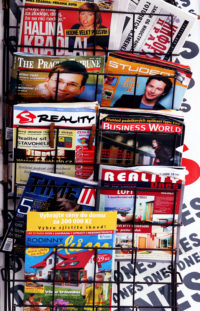
Initially, I was concerned about using the magazine covers on my website. Still am. But the images are so small I’m betting these publishers won’t give me grief about it. At any rate, it’s probably fair use.
But I faced another copyright challenge once I figured out how to add images to my blog posts. I’ve tried to be careful, but it’s not easy – in fact it often seems impossible – to figure out whether images are copyrighted. A Google search for mountains, for example, yields more than 37 million images. If I start clicking through these, a few are obviously copyrighted – they carry the familiar copyright symbol, ©. But most do not. Of course, the law no longer requires a work to display the © symbol for copyright protection. In fact, when I click on any image, Google warns me that “This image may be subject to copyright.” When I click further to go to the original source – which may be a commercial website, someone’s blog, or even a variety of websites that claim to offer “free” images, it’s never clear whether the image is copyrighted. There is no copyright notice on the photo, although there is a copyright notice at the bottom of the website. Presumably this copyrights the website, but not the photo.
When I attended the Future of Freelancing conference last summer, one presenter mentioned that a good way to find images available for legal use was to search Creative Commons (CC). I’ve tried, but remain baffled. Right off the bat, the home page tells me:
“Do not assume that the results displayed in this search portal are under a CC license. You should always verify that the work is actually under a CC license by following the link. Since there is no registration to use a CC license, CC has no way to determine what has and hasn’t been placed under the terms of a CC license. If you are in doubt you should contact the copyright holder directly, or try to contact the site where you found the content.”
In addition, Creative Commons offers a confusing array of different types of licenses that specify different conditions under which I may use the work. So even if I figure out it’s licensed under Creative Commons, I still have to decipher exactly how I’m allowed to use it.
All this means that locating and verifying an image often takes as long as writing the blog post. Sometimes longer. Occasionally, I actually discover the copyright owner and ask for permission. The outpouring of gratitude tells me how widescale this problem is.
Here’s what Richard Krzemien, the author of the cartoon I used in last week’s post, told me about copyright infringement: “I used to keep close track of copyright problems, but honestly it can become a full time job. That’s why I took most of my comics down from the site. And all that’s available are the low resolution versions online. I figure it’s the cost of doing business. So I greatly appreciate you contacting me for permission.”
I’m sure what I’ve run into is just the tip of the iceberg in terms of copyright infringement on the Web. Come to think of it, that would make a good illustration for this post. There are 1.5 million images of iceberg tips on Google. I wonder which ones are legal?
Putting off my post on procrastination
I’ve been meaning to write this post for a week. Really. Then I told myself, “hey, it’s August. Everybody’s on vacation. It’s not like the six people who read my blog are going to actually miss it.”
I put off starting a blog for a long time. I knew once I started I’d have to post regularly. At least that’s what all the experts say. And I knew my habits well enough to understand what that would mean. Without an editor setting a deadline, I expend tremendous amounts of emotional energy just to psych myself into sitting down and writing.Even with an editor imposing a deadline, my procrastination tendencies often back me into a corner when it comes time to file a story. I love to report, conduct research and interview people. I also love to write. But there is this strange no-man’s land in between those two activities, where my brain acts like a seven-year-old with attention deficit hyperactivity disorder.
Unless I’ve got a brilliant idea for a post, or the results of my reporting have yielded a fantastic story that I just can’t wait to tell, anything and everything becomes a diversion. Suddenly, I must:
- Run out for Starbucks. I don’t even like Starbucks.
- Walk the dog, even though I have to wake him up to do it.
- Bathe the dog. Ditto.
- Check my social networks. Facebook alone is good for killing at least an hour.
- Check how the stock market is doing. As if it makes any difference to my pathetic nest egg.
- Search freelance sites for job opportunities. I can always justify the time spent as “marketing.”
- Call former editors and colleagues. Ditto.
- Research some obscure question on the Internet. Did you know that Mozart’s full baptismal name was Johannes Chrysostomus Wolfgangus Theophilus Mozart?
- Perform routine computer maintenance, including deleting thousands of e-mail messages, running security scans and updating software.
- Make personal appointments. Hair cuts. Dental appointments. Don’t I deserve a massage this week?
My personal favorite: Making lists of what I’m going to do on each of the next few days. This makes me feel tremendously productive.
While these things keep me busy, they don’t divert my brain much. I think a lot about what I’m going to write. I compose the article in my head. I like to say that the entire piece is all completed, all that’s left is the mechanics of getting it down on paper. Hell, Mozart did it. “Everything has been composed, just not written down,” he once told his nagging father.
Problem is, I’m not Mozart. And even if I were, that “writing down” part takes a long time, even with a computer. I’d better get started.
Too bad it’s time for my pedicure . . .
Getting bearish about marketing bull
My freelance writing usually falls into one of two categories: straight journalism and custom publishing. Over the last year, as journalism and independent publishing suffers the extinction of the dead-tree business model and desperately searches for digital models that can replace it, custom publishing has become a much larger part of my business.
Custom publishing – producing articles, newsletters and magazines for a corporation or organization – is a form of marketing. As such, the goal of the writing is usually to get someone to buy something. Even the high-brow, glossy custom magazines that publish in-depth articles aimed at top-level executives are selling something. The goal of these magazines is often “thought leadership,” a vague marketing term that means the company is promoting how smart it is. They are trying to get the reader to buy into the image of the leaders of this corporation as particularly intelligent, insightful and strategic thinkers.
Such phrases have started creeping into my vocabulary as I do more custom work. I’ve always been a stickler with myself, and with others whom I edit, about keeping language simple, clear and concise. While many marketers value good writing, some do not. They – and the executives above them – apparently think imprecise, vague language effectively promotes their product or advances their agenda. Granted, the goal is to sell something, to in some way influence the reader’s behavior, but to do that you need to hook readers – by entertaining them, piquing their curiosity or delivering valuable information. Marketing people often think in terms of what they, and their company, want to say, rather than what the reader – their customer – needs. I try to point out to them that few people will actually read their custom magazine or corporate white paper unless it’s interesting, well-written or useful – and preferably all three. And those that do read it aren’t likely to take action if they get the sense that the article is just promoting the company.
But the marketing folks sign the checks. My job is to write what they want in the way they want it. So I cringe, subvert my hard-earned skills and write how I’m told. I write about challenges, rather than problems. There are no products or services – they are all solutions. Some are even, God forbid, unique solutions. And these solutions are often optimized, a word that runs all too rampant in marketing copy. (To optimize is to “make as effective, perfect or useful as possible.” If you have to optimize a product, that implies it wasn’t very effective or useful to start with.) All the while I imagine my notoriously loud and dictatorial journalism professor, John Bremner, rolling over in his grave and screaming “barbarisms!” (Yes, that word applies to writing. According to Dictionary.com, definition #3: “the use in a language of forms or constructions felt by some to be undesirably alien to the established standards of the language.”)
I know I shouldn’t complain. After all, in a strict business sense, my goal is to please my customer. Still, it gives me a stomach ache to write this way. And that’s not all. Like a fungus in a dark room, these marketing phrases and meaningless executive pronouncements proliferate and sneak into my journalism. It doesn’t help that I often interview marketing people, as well as executives, for my stories, and thus am exposed to these phrases on several fronts.
How to combat this? One of the best antidotes I’ve found is editing work. In college, Bremner seared so many editing commandments into my brain that I somehow channel him when I edit other’s work. My ability to sniff out the inexact phrase or dangling participle becomes keener when I read someone else’s copy. When I don’t have others to edit, I try to bifurcate my personality. I’ll write a draft of something, let it sit for a day, and then come back to it with my merciless Bremner persona, red pen ready to slash.
The other method is to really listen and think when I interview people. Even journalists – who are professional listeners as well as writers – sometimes get lazy as they take in the answers to their questions. I try to remember to ask, at least once during any given interview, some version of the question: “What the hell does that mean?” More diplomatically than that, of course. For example, the other day a CIO was explaining to me a strategic move that his company made. “They were charged to come back with a change in communication initiatives to drive better alignment for not only the IT organization, but also drive better alignment for the enterprise.” I was able to partially translate as: “I asked them to tell me how .. .” but I had no idea what he meant by better alignment. So I asked. His answer got into important details that enabled me to write a much more interesting and useful story for the reader.
Whether the reader is a magazine subscriber or a customer, that should always be the goal.